Live on the road
The Newport Mansions Audio Tour
Whistlestop narrates far more of the drive than this guide can list, automatically, as you pass each one.

The field guide
The avenue
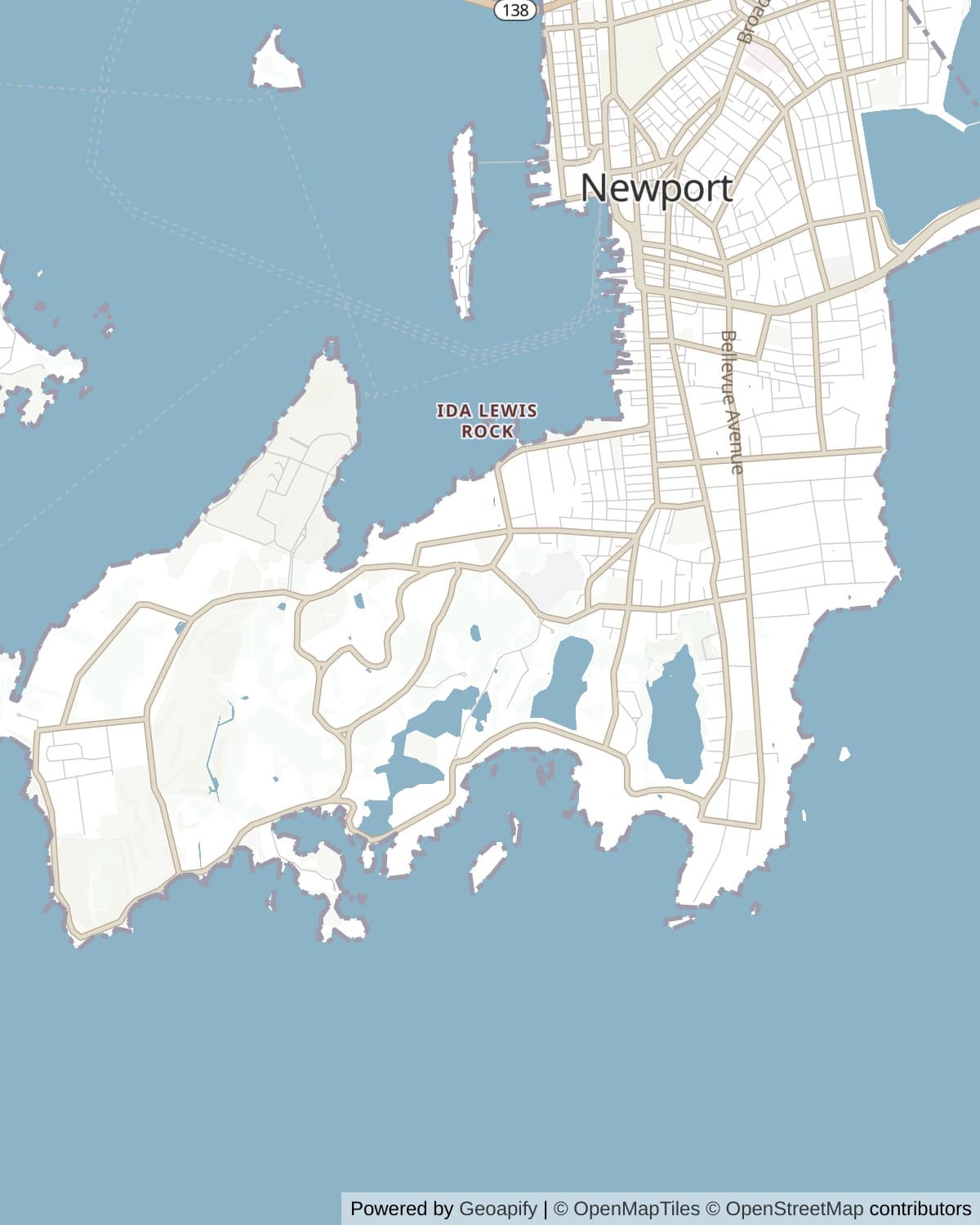
Bellevue Avenue runs about two miles from the Newport Casino south to the sea at Bailey's Beach, and the whole corridor has been a National Historic Landmark district since 1976. Newport was a resort long before it was a spectacle: Southern planters like Kingscote's George Noble Jones came north from the 1830s to summer away from the heat, and China-trade families like the Wetmores and the Kings built the first generation of villas with money made in Canton. For decades the avenue's houses were wooden, Gothic, and merely large.
Then the railroad money arrived and the arms race began. Chateau-sur-Mer, the grandest house in Newport from 1852, held the title for forty years and lost it in a single decade: Ochre Court and Marble House in 1892, The Breakers in 1895, Belcourt in the same years, The Elms in 1901, Rosecliff in 1902. In roughly ten years the avenue went from wooden villas to limestone and marble palaces, most of them by the same handful of architects, several of them within sight of each other's lawns.
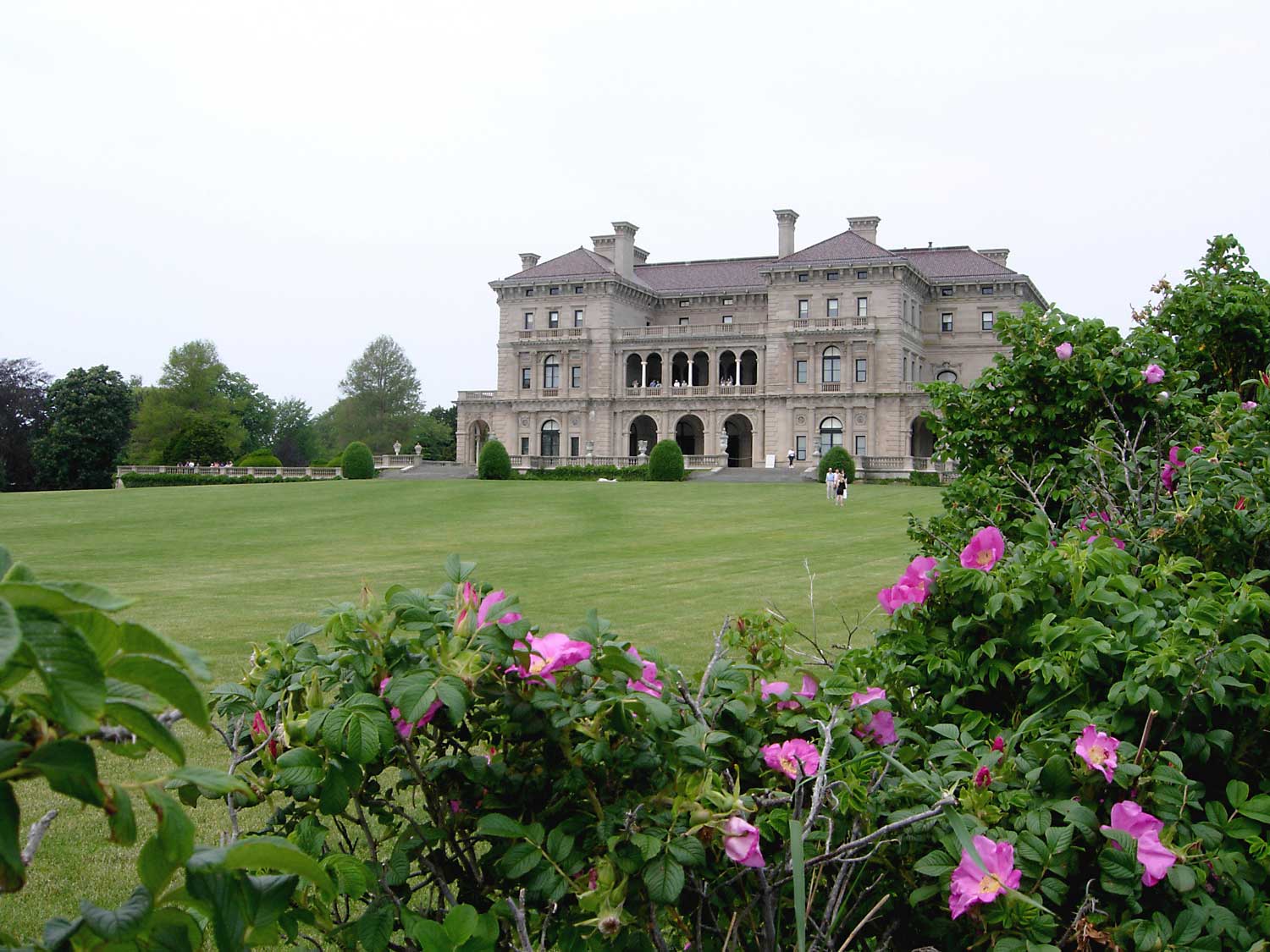
Everyone called them cottages, and the understatement was the point. A cottage was a summer house, whatever its size, and the size was considerable: 70 rooms at The Breakers, a live-in staff of about 40, and an owner in residence for six or eight weeks a year. The rest of the year the houses stood shuttered on the cliff, monuments waiting for July.
The season and the 400
The Newport season ran through July and August, six or eight weeks in which the social year was decided. The choreography was fixed: mornings at the Casino, afternoon carriage parades down Bellevue and around Ocean Drive, then dinners and balls that a serious hostess mounted on a near-industrial scale. The competition was real, the budgets were unlimited, and the arbiter of who mattered was one woman: Caroline Schermerhorn Astor, the Mrs. Astor, at Beechwood.
Her gatekeeper was Ward McAllister, who declared that fashionable New York held only 400 people, a number pegged, by his own telling, to the capacity of her Manhattan ballroom. When rival lists forced his hand and he finally dictated the roll to the New York Times in February 1892, it contained just over 300 names, which tells you most of what you need to know about how the legend was maintained. Newport in August was where the list was enforced: an invitation here was the difference between being in society and merely being rich.
Even the beach was a membership question. Bailey's Beach, at the southern end of the avenue, was organized in the 1890s as the private Spouting Rock Beach Association after new trolley lines filled Easton's Beach with day-trippers, and it remains a private club today. The era got its name from a novel: Mark Twain and Charles Dudley Warner called their 1873 satire The Gilded Age, gilded rather than golden, and Bellevue Avenue built the metaphor in stone.
Hunt, White and the borrowed kingdoms
One Paris-trained architect built an astonishing share of this street. Richard Morris Hunt rebuilt Chateau-sur-Mer in the 1870s, then delivered Ochre Court, Marble House, The Breakers and Belcourt in a single decade, along with the ballroom at Beechwood. His clients were not buying floor plans, they were buying legitimacy: The Breakers is worked up from the Renaissance palaces of Genoa, Marble House from the Petit Trianon, Ochre Court from the chateaux of the Loire, Belcourt from a Louis XIII hunting lodge. New money, one generation deep, dressed itself in the oldest architecture it could find.
The alternative was homegrown. McKim, Mead & White got their first major commission at the Newport Casino in 1880 and used the town to work out the Shingle Style, an American architecture of wood, shade and open plans whose best surviving example is the Isaac Bell House of 1883; their 1881 dining room at Kingscote, lined with Tiffany glass bricks, is the movement in miniature. Stanford White returned in maturity to build Rosecliff on the pattern of the Grand Trianon, so the firm ended up fluent in both languages.
The rest of the roster reads like a census of the profession: Horace Trumbauer translating a French chateau into The Elms for a coal baron, Peabody & Stearns building Rough Point for a Vanderbilt, the Olmsted firm laying grounds up and down the cliff. For American architecture, the avenue was less a neighborhood than a proving ground with unlimited funding.
Who actually ran the houses
Every cottage was a workplace. The Breakers ran on a live-in staff of about 40 in season, housed on the upper floors of the same house whose Great Hall rose fifty feet; Marble House kept 36. The machinery was deliberately invisible: at The Elms, coal came in through an underground tunnel and the house was among the first in America to run entirely on electricity, and the guest floors were engineered so that the people making the place work were never seen doing it.
The Preservation Society's Servant Life Tour at The Elms is the corrective, built around the actual staff by name, the butler and the cook and the maids, and the stairs they climbed between basement and attic. It is the one tour on the avenue about labor rather than taste, and it reframes every marble room you walk afterward.
The staff had their own geography. Heritage accounts of the Forty Steps, the staircase where Narragansett Avenue meets the cliff, describe the servants of the surrounding houses gathering there on summer evenings off, dancing to accordion music over the water. The lawns belonged to the 400; the steps belonged to everyone else, and they still do.
The walk beneath the lawns
The Cliff Walk runs three and a half miles down Newport's eastern shore, from Easton's Beach to Bailey's Beach, squeezed between the ocean and the back lawns of the very houses this guide is about. It was designated a National Recreation Trail in 1975, the first in New England, and it is free at every hour the mansions are not. Walking it southward, the seaward faces of Ochre Court, The Breakers, Rosecliff, Beechwood, Marble House and Rough Point come up one after another, which is the closest the Gilded Age gets to a museum hall you can smell salt in.
It exists because Rhode Island's shore was public before any of these families arrived. The colony's 1663 royal charter promised its people the fishery along the coast, the state constitution still guarantees the privileges of the shore, and that inheritance is why a public footpath survives across some of the most expensive private ground in America. The houses came to the cliff; the right of way was already there.
One stretch is broken. A section between Narragansett Avenue and Webster Street collapsed into the sea on 3 March 2022, and as of August 2026 it has not reopened: a signed detour loops inland around Salve Regina University and adds about half a mile, roughly $22 million in repair money is secured, and the engineering plan is still in front of the state's coastal council with no reopening date announced. The rest of the walk, three quarters of it including everything south past The Breakers, is open. Check the City of Newport's Cliff Walk page before promising anyone the full 3.5 miles.
The fall, and the rescue
The world that paid for all this ended quickly. The federal income tax arrived in 1913, the First World War made conspicuous consumption unfashionable, and the 1929 crash made much of it impossible; houses built to burn money began to consume estates that no longer replenished. Through the middle of the century many of the cottages were demolished, lost to fire, or cut into apartments, and by the 1960s a Bellevue Avenue mansion was something you could buy for less than the cost of its fence.
The counterattack was organized in 1945, when a group led by Katherine Urquhart Warren founded the Preservation Society of Newport County to save the colonial Hunter House. Then came the mansions, one rescue at a time: The Elms bought for $116,000 in 1962 with demolition scheduled, Marble House in 1963 with Harold Vanderbilt's money, Chateau-sur-Mer in 1969, Rosecliff given furnished and endowed in 1971, The Breakers sold by Vanderbilt heirs for $365,000 in 1972, the Isaac Bell House in 1994. The Society now opens eleven properties, seven of them National Historic Landmarks.
Doris Duke ran a parallel rescue at street level. Her Newport Restoration Foundation, founded in 1968, bought and restored more than seventy of the town's endangered colonial houses and rents them to tenant stewards, which is why the blocks below the avenue still look like the eighteenth century; her own Rough Point opened as a museum in 2000, left as she lived in it. The strangest coda is the newest: HBO's The Gilded Age films in seven of the Preservation Society's houses, with The Breakers and The Elms standing in for Fifth Avenue, so the cottages have ended their first 130 years employed as themselves.
How long to give it
Half a day
One great house and the water it faces. Book a morning timed slot at The Breakers, then walk the open Cliff Walk stretch below it from the Ruggles Avenue access, drive Bellevue south past the gates to Rough Point, and leave town around Ocean Drive with a stop at Brenton Point.
The Breakers · Marble House · Rough Point · Brenton Point State Park
One day
Two interiors and the whole geography. The Breakers first on a timed ticket, Marble House on the two-house bundle, a picnic hour on the Cliff Walk at the Forty Steps, then the full sweep down Bellevue and around Ocean Drive to Fort Adams for the late light.
The Breakers · Marble House · The Forty Steps · Chateau-sur-Mer · Rough Point · Brenton Point State Park · Fort Adams
A weekend
The full syllabus: the marble palaces, the Shingle Style rebuttal, the servants' story and Doris Duke's house on the rocks. Spread the interiors across two days, nobody enjoys a fourth ballroom in one afternoon, and give the second morning to the Casino's grass courts and the walkable top of the avenue.
The Breakers · Marble House · The Elms · Rosecliff · Rough Point · Newport Casino · Kingscote · Isaac Bell House · The Forty Steps · Brenton Point State Park · Fort Adams
When to come
Summer is the season the houses were built for and the season they are all open: every property runs daily hours from late June through early fall, the Casino's grass is in play, and the trolley is free. It is also when Newport is fullest, so book The Breakers' timed entry ahead and treat weekend middays on Bellevue as slow-moving. September and October may be the trip at its best, with the crowds thinned, the ocean still warm on the Cliff Walk, and the light at Brenton Point doing the avenue's work for it.
Winter narrows the roster but does not close it: The Breakers, Marble House and The Elms have run daily holiday openings dressed for the season, with reduced schedules into the new year, while the smaller houses shut. The Cliff Walk is open year-round and is a different, better walk in a November gale, provided you dress for a path with no windbreak between you and Portugal.
Know before you drive
- Tickets, as of 2026: The Breakers is $32 for adults with a timed entry slot, every other Preservation Society house is $25, and the bundles are the honest buy: The Breakers plus one house $45, plus two $57, valid a year. Rough Point is a separate organization at $25, free for Newport County residents; Belcourt runs its own guided tours Friday through Sunday.
- Two 2026 restoration closures to know before promising anyone an interior: The Elms suspended tours from 10 August for several weeks ahead of a reworked visit promised for fall, and The Breakers' back terrace is closed for restoration January through November. Check newportmansions.org the week you travel.
- The Cliff Walk is missing its Narragansett-to-Webster section, closed since the March 2022 collapse, with a signed inland detour around Salve Regina; as of August 2026 there is no reopening date. Everything south of the detour, including the stretch below The Breakers, is open.
- Parking is free at the Preservation Society houses, and the Cliff Walk has a pay-by-plate lot at the Forty Steps, at the ocean end of Narragansett Avenue, with a four-hour limit in season. Bellevue Avenue itself is a working city street: park in the lots, not along the hedges.
- In season you can skip the car entirely between houses: RIPTA's Route 67 trolley runs the length of Bellevue every 15 to 20 minutes and is free from late May through October in 2026, with a $5-a-day park-and-ride lot at the Gateway transportation center downtown.
- Arriving from the west, the Pell Bridge toll is all-electronic with no cash option: $4.25 with E-ZPass, more by plate. Newport is about 40 minutes from Providence and an hour and a half from Boston, and summer Saturday arrivals earn every minute of it.
- Interiors are toured on foot at a museum's pace. Two houses in a day is comfortable, three is a march, and the audio tour at The Breakers takes most of two hours done properly, so plan the day around fewer doors than you think.
In an RV or with a trailer
There is no campground in Newport itself; the close option is the town-run Melville Ponds campground in Portsmouth, about five miles up the island, with full-hookup sites. Downtown lots restrict oversized vehicles, so park a big rig outside the center, or at the Gateway center's limited larger spaces, and ride the free seasonal trolley down Bellevue; Ocean Drive is a narrow two-lane loop that a large motorhome should take slowly, with Brenton Point offering the one generous lot.
Questions
- Which Newport mansion should you tour if you only have time for one?
- The Breakers. It is the largest, the most intact, and the one whose story contains the others; the self-guided audio tour is excellent and takes about two hours. It costs $32 with a timed entry slot, so book before you drive, and if a second house fits, the $45 bundle makes Marble House nearly half price.
- Can you see the Newport mansions without paying?
- Genuinely well. The Cliff Walk is free and passes directly below the ocean lawns of Ochre Court, The Breakers, Rosecliff, Beechwood, Marble House and Rough Point; Bellevue Avenue and Ocean Drive are public roads; the Newport Casino's grounds are free to walk; and Brenton Point and Fort Adams are free state parks. The interiors are the only thing behind a ticket.
- Is the Cliff Walk fully open?
- Not quite, and this is worth checking the week you go. The section between Narragansett Avenue and Webster Street has been closed since it collapsed into the sea in March 2022; a signed detour loops inland around Salve Regina University and adds about half a mile. As of August 2026 the repair is funded but unscheduled. The rest of the walk, including the famous stretch past The Breakers, is open.
- Why are the Newport mansions called cottages?
- It was the era's own studied understatement: a cottage meant a summer residence, whatever its scale, and the people who summered in 70-room marble houses liked the modesty of the word. Nobody was fooled at the time either.
- Where was HBO's The Gilded Age filmed in Newport?
- In seven Preservation Society properties: The Breakers, Marble House, The Elms, Rosecliff, Chateau-sur-Mer, Kingscote and Hunter House. The show composites them into its New York interiors, so the Russells' Fifth Avenue palace is partly The Breakers' rooms and The Elms' kitchen, all of which you can stand in.
Connects to
Sources: Preservation Society of Newport County, house histories, Preservation Society tickets and hours, Cliff Walk, City of Newport, Cliff Walk repair status, The Public's Radio, August 2026, History of the Newport Casino, International Tennis Hall of Fame, Rough Point and Doris Duke, Newport Restoration Foundation, Ochre Court, Salve Regina University research guides, Fort Adams history, Rhode Island State Parks.
Reviewed August 2026
Hear it from the road
Whistlestop tells you these stories automatically as you pass them. No searching, no tapping, nothing to ask.