About
Made for the places between.
Whistlestop is a hands-free road-trip guide for iPhone. It watches the road ahead, works out what you're about to pass, and tells you the story before you get there: the landmarks, the history, the nature, and the legends most people drive by without ever knowing. It's built for families who still look out the window.
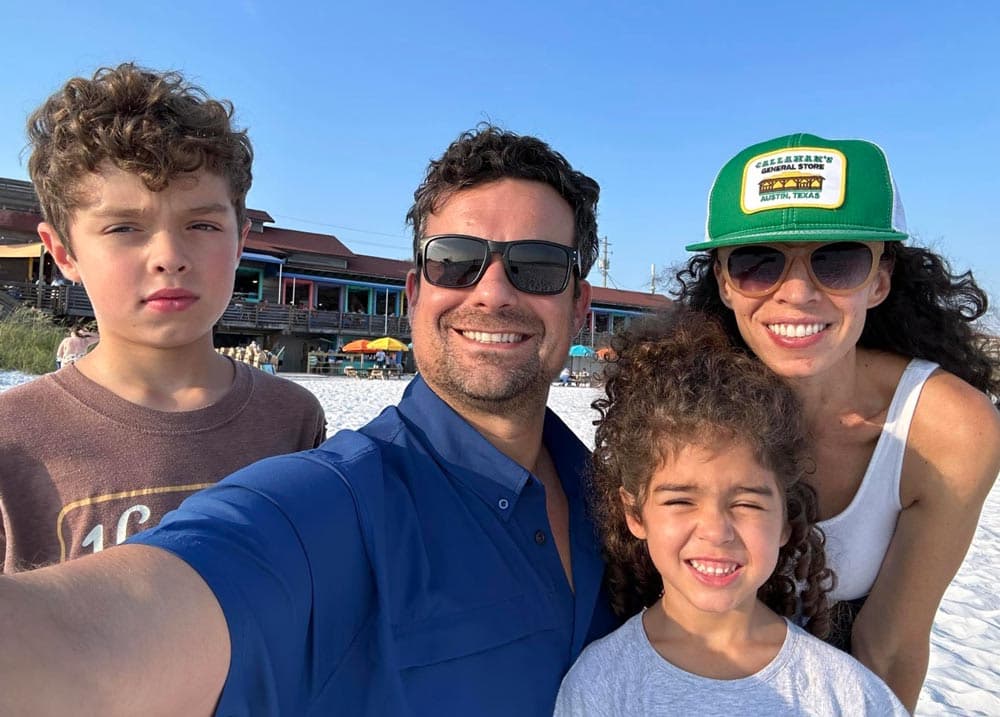
Carson Coots
Founder · Austin, Texas
Who's behind it
I'm Carson Coots, a documentary filmmaker and web designer living in Austin, Texas with my wife Anna and our kids.
Our family takes a lot of road trips. Austin to Illinois to see Anna's side of the family, winding through the Missouri Ozarks and the flat plains of Oklahoma. Texas to Florida for Miramar Beach. West to Ruidoso, New Mexico. The destinations are cool, but the real memories are made in the places between.
A few years ago Anna got us into geocaching. Suddenly every stretch of highway had a reason to pull over. Even when we weren't hunting caches, we'd pass some odd building, a crumbling bridge, a lonely historical marker, or an old cemetery and wonder what the story was. Anna would look it up and read it out loud. Those little discoveries always sparked more questions and better conversations than anything on a screen.
We kept saying the same thing: wouldn't it be great if something just told you what you were driving past?
Building that kind of app used to feel impossible. Then AI advanced far enough that voiceovers and location-aware storytelling became realistic. So I decided to make it.
I want Whistlestop to be the ultimate road-trip companion: a second set of eyes looking out the window with you, ready to share the histories and stories you would have otherwise missed. Before phones and tablets, road trips were spent staring out at the world and wondering. Whistlestop brings that curiosity back, only now you actually get answers.
We're just getting started. More stops, more stories, more reasons to keep looking out the window.
How it works
The longer version →Press start, then drive
No route to enter and nothing to plan. It watches the road ahead, scanning a corridor a few minutes out at your current speed rather than a circle around you.
It finds what's worth hearing
Anything with a Wikipedia article and coordinates is fair game, weighted by how good the story is and how close it sits to your line.
It speaks up on its own
The story is written for the moment you'll pass it and read aloud in the voice you picked. Not interested? Skip, from the steering wheel.
And one thing it doesn't do: listen. There's no microphone code in the app and it never asks for the permission, because a guide that talks to you has no reason to. What actually leaves your phone, in plain English.
What's next
A short list, in roughly the order we're working on it. No dates, because the road is long.
Launch on iPhone
Done. Whistlestop went live on the App Store on 25 August 2026. The first fifteen stops are free, and Road Tripper is $9.99 a month after that.
More historical markers
Thousands of historical places across the country are already on Whistlestop, and we've just added 10,000+ more marker locations in Texas alone. More states are coming in the weeks ahead.
More natural features
We've been curating stories for the natural world along the road — the rock formations, rivers, and valleys, and the plants and wildlife that make a stretch of country what it is.
More local stories
Local places carry legends, and we want to hear more of them. These take careful curation, so we're rolling them out in phases.
Know a place that deserves a whistlestop? The odd marker, the bridge with the story, the thing your town is quietly famous for? Send it over. The best curated stops start as somebody's tip.
Come along.
Whistlestop is out now on the App Store, for iPhone. The first fifteen stops are free.