Live on the road
Mississippi Blues Trail Audio Tour
Whistlestop narrates far more of the drive than this guide can list, automatically, as you pass each one.

The field guide
The land that made it
The Mississippi Delta is not a river delta. It is a leaf-shaped alluvial floodplain about 200 miles long and 87 across at its widest, some 4.4 million acres between the Mississippi on the west and the Yazoo on the east, laid down over thousands of years of flooding and famously flat: the joke that it runs from the lobby of the Peabody Hotel in Memphis to Catfish Row in Vicksburg is a cultural claim rather than a survey, but the ground really does barely move. That silt is some of the most productive cotton soil on the continent, which is the whole story underneath the music.
It was swamp and hardwood forest until after the Civil War, cleared late and mostly by Black labor, and by the 1900s it was worked under sharecropping: a system where a family farmed a plot for a share of the crop, settled up once a year against a plantation store's own ledger, and frequently ended the year owing money. Plantations here were measured in tens of thousands of acres, and Dockery's 25,600 was a town in everything but name, with its own currency and post office. The blues came out of that arrangement, not out of some general idea of hardship, and the specific arrangement matters: it concentrated tens of thousands of people, gave them Saturday night and nothing else, and left them free to move between plantations in a way that carried songs.
Where it actually started
Nobody invented the blues on a particular afternoon, but the documentary record has an unusually sharp first sighting. Around 1903 W.C. Handy, a formally trained bandleader from Alabama, was waiting for a delayed train at Tutwiler and woke to a man playing slide guitar with a knife blade against the strings, singing about going where the Southern cross the Dog. Handy did not invent what he heard, and he knew it. What he did was write it down and publish it, which is why he is called the father of the blues by people who mean the father of the sheet music.
The music itself belongs to Dockery Farms and places like it. Charley Patton lived on the Dockery place on and off for nearly thirty years and is the closest thing the Delta blues has to a founder: a small, loud, theatrical performer who played behind his head and could be heard, people said, half a mile off. Howlin' Wolf learned from him directly. Willie Brown, Tommy Johnson and Pops Staples all moved through the same few square miles. Son House, who taught Muddy Waters more than anyone, played the same circuit.
There is a second, stranger strand at the southern end. In Bentonia, well outside the Delta, a minor-key style with an eerie open tuning developed around Henry Stuckey, passed to Skip James and Jack Owens, and survives today in one man, Jimmy Duck Holmes, in one room. It is the clearest reminder that this music was regional in a way that is hard to grasp now, when everything is a click apart: styles could belong to a few miles of road.
The crossroads, honestly
The story is that Robert Johnson took his guitar to a crossroads at midnight and traded his soul to the devil for the ability to play it. It is a genuinely old folk motif, it attached itself to Johnson after his death rather than during his life, and the earlier version was told about Tommy Johnson, no relation, by his own brother. No location is documented. Dockery, Rosedale, Beulah, Ruleville and Memphis have all been nominated.
Clarksdale's claim is municipal rather than historical: the local intersection of Highways 61 and 49 had been called the crossroads since the 1930s, and in April 1999 the city took a resolution to the state legislature designating it as the crossroads. Then in 2004 the highways were renumbered when the bypasses opened, so the three blue guitars now stand near, but not at, the junction the resolution was about. None of this is a secret and none of it stops it being a good thing to stand at.
The verifiable Johnson is more interesting than the legend anyway. He recorded 29 songs across two sessions, in San Antonio in 1936 and Dallas in 1937, and died on 16 August 1938 near Greenwood at 27, having been poisoned at a country store three days earlier. He sold poorly and was largely unknown outside the Delta. The 1961 reissue King of the Delta Blues Singers is what reached Keith Richards, Eric Clapton and Bob Dylan, and the reason the myth grew so large is partly that so little of the man survived to contradict it: two verified photographs, one voice, no film.
He has three graves. A marker went up at Payne Chapel in Quito in 1990, paid for by an Atlanta rock band; Columbia Records put a one-ton obelisk at Mount Zion near Morgan City in 1991. Both were guesses. In 2000 Rosie Eskridge, then in her eighties, said her husband Tom had dug the grave and she had been there, and pointed at the churchyard at Little Zion on Money Road. That is where the Blues Trail put its marker, and it is where to go.
Up Highway 61
Between roughly 1910 and 1970 about six million Black Americans left the South, and Mississippi sent more people to Chicago than any other state. The Illinois Central ran straight from the Delta to the South Side, and Highway 61 ran alongside it, which is how a farm road became a metaphor. Some 150,000 Mississippians reached Chicago in the 1940s alone, pulled by wartime factory work and pushed by the mechanical cotton picker, which arrived in the Delta in the same decade and did the labor of dozens.
The music went with them and changed on arrival. Muddy Waters left Stovall in 1943, plugged in because acoustic guitars could not be heard over a Chicago room, and by the early 1950s had assembled the amplified band format that rock and roll took wholesale. Howlin' Wolf, Willie Dixon, Little Walter and Sonny Boy Williamson made the same journey. Chess Records was the destination. What is often missed is how short the chain is: the man Alan Lomax recorded on a Mississippi porch in 1941 was on the same label as Chuck Berry by 1955.
The Delta that supplied all this emptied out. Towns on this route have lost half their population or more since 1950, and several of the counties here are among the poorest in the United States. That is not background color to the drive, it is the visible condition of most of the places you will stop, and the reason so many of the markers stand in front of empty lots.
How the trail works
The Mississippi Blues Trail was created by the Mississippi Blues Commission in 2006, and there are now more than 200 markers, the great majority in Mississippi and a scattering elsewhere, from Chicago to Norway. Each is a two-sided steel sign with a substantial essay on it, researched properly and usually carrying more detail than the site itself offers. There is no fee, no gate and no order: they sit on roadsides, in churchyards, outside shuttered stores.
That is the honest character of this drive. A good proportion of these places are a marker in front of an absence, and if you arrive expecting attractions you will feel short-changed by mid-afternoon. Read the signs, which are the exhibit. The full marker text for every one is online at msbluestrail.org, and reading ahead is the single thing that most improves the trip.
The paid institutions are the exceptions and they are all worth the money: the Delta Blues Museum in Clarksdale, the B.B. King Museum in Indianola, GRAMMY Museum Mississippi in Cleveland and the Highway 61 Blues Museum in Leland. Between them they cover what the roadside cannot, which is the sound.
What is left of the juke joints
A juke joint was an informally licensed room, usually on plantation land, where Black workers drank and danced on Saturday nights outside white supervision. There were hundreds across the Delta. There are now, in any meaningful working sense, a handful, and the arithmetic has been brutal in a short time: Po' Monkey's outside Merigold, the last real rural one, closed when Willie Seaberry died in 2016 and has not reopened.
What survives is worth planning around rather than hoping for. Red's Lounge in Clarksdale still operates on its own terms and its own hours. The Blue Front Cafe in Bentonia has been open since 1948 and Jimmy Duck Holmes still plays there, which makes it the oldest surviving juke joint in the state and the only place to hear the Bentonia style where it was made. Ground Zero Blues Club in Clarksdale, co-owned by Morgan Freeman since 2001, is the comfortable end of the spectrum and books real players; it reopened in March 2025 after a fire.
The reliable answer is to come for a festival. Clarksdale's Juke Joint Festival in April turns roughly two dozen venues into stages for a day and is the one weekend when the town looks the way visitors imagine it the rest of the year.
More stories about places in and around the Delta
Whistlestop's audio tours work wherever you are, automatically as you drive past landmarks and areas of interest. Here are some more curated stories you'll hear around the Delta.
Local Stories
Muddy Waters's Cabin
Read
McKinley Morganfield, known as Muddy Waters, spent most of his first thirty years in a cabin on this part of Stovall Farms, sharecropping and driving a tractor, and by the early 1940s running a juke house on the side with a gambling wheel, a jukebox and whiskey he made himself. In August 1941 Alan Lomax and John Work arrived on a field recording expedition funded by the Library of Congress and Fisk University, set portable disc cutting gear up in the house, and recorded him along with the fiddler Henry Son Simms. Lomax returned with Lewis Jones in 1942. Waters had never recorded before, and what he remembered was the playback: he sounded, he said, just like anybody's records, and he took the pressing Lomax sent him up to the corner, put it on the jukebox, played it and played it and told himself he could do it. He left for Chicago in May 1943, after an overseer refused him twenty five cents an hour for driving the tractor. He came by his first electric guitar in the mid 1940s, bought or given by an uncle depending on the account, and the amplified band sound he built on it ran directly into rock and roll. Thirteen of the Lomax sides came out in 1966 as Down on Stovall's Plantation and the full set in 1993, preserving the acoustic Delta player he was beforehand. The cabin is no longer on the site: what survived of it was dismantled, toured by the House of Blues from 1996, including the Atlanta Olympics, sat in a warehouse, and was finally rebuilt from its original cypress boards inside the Delta Blues Museum. Stovall Farms remains in the family that gave it its name.
Muddy Waters's Cabin on Whistlestop →Early Wright
Read
Early Wright went on the air at WROX in Clarksdale in 1947 and became the first Black disc jockey in Mississippi. Born on 10 February 1915, he was an auto mechanic by trade, with a repair shop in the town from 1937, and he came to the station in 1945 as manager of a gospel group called the Four Star Quartet. He was recording an announcement for them when the station manager, Preston Hinman, noticed his voice and offered him a show of his own. He kept it for half a century. The programme ran four hours a night and he split it in two with a persona for each half: the Soul Man, who played blues, and Brother Early, who played gospel. Musicians came in to be interviewed and to plug a show that night, among them Muddy Waters, B. B. King, Sonny Boy Williamson, Pinetop Perkins and Robert Nighthawk. So, early in his career, did Elvis Presley. What the job actually was is easy to miss at this distance. A Black voice on a commercial station in the Mississippi Delta in 1947 was close to unheard of, and the show carried more than records: community events, church notices, funeral announcements, and advertising for the stores across the tracks that served Black customers, sponsors Wright signed himself. He broadcast from 257 Delta Avenue until 1955 and from the Alcazar Hotel on Third Street afterwards, and he was still on the air in the 1990s. He died on 10 December 1999. A WROX museum opened in the Delta Avenue building in 2004; the Alcazar, built in 1915 and once reckoned the best hotel in the state, stands vacant.
Early Wright on Whistlestop →The Clarksdale Depot
Read
The passenger depot on Blues Alley opened on 7 May 1927, built for the Yazoo and Mississippi Valley Railroad, a subsidiary of the Illinois Central chartered in 1882, as part of an agreement with the city to raise the tracks through Clarksdale. It replaced an earlier station on a line that mattered more than most. The Illinois Central ran north through Memphis to Chicago, and it made the Mississippi Delta and the South Side of Chicago something close to neighbouring places. People left along it in enormous numbers, following relatives who had gone before and become contacts for the next ones, and Pullman porters carried bundles of the Chicago Defender south, a paper that organised migrant clubs and arranged group discounts on the northbound fare. Roughly six million Black Americans left the South between 1916 and 1970. The Delta's own emptying came late and came from machinery. The boll weevil had reached Mississippi in 1907 and cotton prices collapsed after 1920, but Delta planters were recruiting labour in those years rather than losing it, and Coahoma County held a virtually unchanged population from 1930 to 1960. It was mechanised picking that ended the need for hands, and the exodus that followed the Second World War was the larger one. The music went north on the same trains and became something else when it arrived: Muddy Waters left Clarksdale for Chicago in 1943, came by an electric guitar in the mid 1940s, and turned the acoustic Delta blues into the amplified Chicago sound that rock and roll was built from. The depot has held the Delta Blues Museum since 1999.
The Clarksdale Depot on Whistlestop →The New World District
Read
Clarksdale's Black business and entertainment district took its name around the turn of the twentieth century from Nelson Jones's New World, a saloon and rooming house on the south side of the Yazoo and Mississippi Valley tracks. It ran along Issaquena Avenue south of the railroad and round to Fourth Street, now Martin Luther King Boulevard, and it was sometimes called the Beale Street of Clarksdale. Before the Second World War it held shops, saloons, cafes, theatres and bordellos, and the music in it was ragtime and jazz as much as blues. W. C. Handy lived at 317 Issaquena Avenue from 1903 to 1905 and his orchestra played the district on its big nights. Howlin' Wolf, John Lee Hooker and Son House all performed in the New World, and its rooms over the decades included Wade's Barbershop and Lounge, the Casanova, the Blue Den, the Roxy and New Roxy theatres, and for many years the district's main blues venue, the Red Top Lounge on Yazoo Avenue. The brick buildings that survive are not the originals. A fire swept the district around 1920 and what stands went up afterwards, by which time curfews from 1914 and wartime restrictions had already ended the freewheeling era, though the district stayed busy. What emptied it was mechanised cotton and the Great Migration taking the people. Blues tourism has since rebuilt downtown Clarksdale, which was the white side of town under segregation, while the New World, where the music was actually played, has largely not been rebuilt: the New Roxy's marquee now masks a collapsed roof. There is no National Register district here, only a heritage trail marker, which is part of the same story.
The New World District on Whistlestop →Aaron Henry's Drugstore
Read
Aaron Henry qualified as a pharmacist at Xavier University in New Orleans in 1950 and opened the Fourth Street Drug Store in Clarksdale in partnership with a white Mississippian, K. W. Walker. By his own account the shop became the gathering place and the hub for political and civil rights planning for three decades. He founded a Clarksdale branch of the NAACP in 1953 and was president of the state conference by 1959, led the Council of Federated Organizations from 1962 to 1965, the umbrella that ran the Freedom Summer voter registration drive, and in August 1964 headed the Mississippi Freedom Democratic Party delegation that challenged the seating of the all white state delegation in Atlantic City. In November 1963 he stood for governor in the Freedom Vote, a parallel election run to prove Black Mississippians would vote if allowed, with Ed King of Tougaloo College for lieutenant governor. More than eighty thousand ballots were cast in churches, shops and front rooms. The reprisals were thorough and they reached past him. He was arrested more than thirty times, once chained to a garbage truck and walked to the jail. His home was firebombed and the pharmacy was vandalised and firebombed. His wife Noelle was sacked from her teaching job, and five Coahoma County NAACP officers were convicted of running an illegal boycott and given six months and six hundred dollar fines. Freedom Summer volunteers arriving in 1964 were met at the counter with a Coca-Cola and encouragement, under photographs of King, the Kennedys, and Chaney, Schwerner and Goodman. Henry sat in the Mississippi House from 1980 until 1996 and died in 1997. The drugstore burned in 1993 and the lot is empty.
Aaron Henry's Drugstore on Whistlestop →The G.T. Thomas Hospital
Read
The building on Sunflower Avenue opened on 12 July 1916 as the Clarksdale Colored Hospital, was later the Ancient Order of Watchmen Hospital and then the G. T. Thomas Afro-American Hospital, and served Black patients of the Delta until 1942. On 26 September 1937 Bessie Smith, the highest paid Black entertainer in the country a decade earlier, was brought here after a road crash about sixteen miles north of Clarksdale on Highway 61, and died of her injuries. A story still widely repeated holds that she bled to death because a whites only hospital turned her away. It is false, and its origin is traceable: the record producer John Hammond wrote it up in Down Beat in November 1937 from hearsay, placing the accident in Memphis. He acknowledged thirty four years later that he had relied on second hand talk, and Down Beat itself reinvestigated and printed a correction. What happened is better documented than the myth. A Memphis physician, Hugh Smith, was driving to a fishing trip, was flagged down and gave first aid at the roadside, and an ambulance took her to the Black hospital, which as Smith later put it is the only place an ambulance would have taken her. Chris Albertson, whose biography demolished the refusal story, nonetheless faulted the delay before she reached any hospital, so the question of what race cost her that night is narrower than the legend and is not closed. In 1943 Z. L. Ratliff Hill leased the building and opened it in 1944 as the Riverside Hotel, buying it outright in 1957. Segregation left Black travellers few places to stay, and Sonny Boy Williamson, Ike Turner and Robert Nighthawk all did. Hill ran it until her death in 1997 and her family after her.
The G.T. Thomas Hospital on Whistlestop →The Crossroads
Read
The junction of the old routes of Highways 61 and 49 at Clarksdale was locally the crossroads by the 1930s, and blues audiences later took it for the crossroads, where Robert Johnson is said to have met the devil at midnight and traded his soul for the ability to play. Almost none of that attaches to Johnson in his lifetime. He recorded Cross Road Blues in San Antonio in November 1936 and Me and the Devil Blues in Dallas in June 1937, and while the second has the devil knocking at the door, neither song describes a bargain; the appeal in Cross Road Blues is to the Lord, and what it describes is a Black man stranded at a country junction after dark, which in Mississippi in 1936 was danger enough. The legend arrived after the records did. Columbia reissued him in 1961 as King of the Delta Blues Singers, Cross Road Blues placed first, and in 1966 the critic Pete Welding published an essay in Down Beat quoting Son House to the effect that Johnson had dealt with Satan. Welding never produced the tape and no transcript survives. A comparable story had been told about a different musician, Tommy Johnson, by his brother LeDell, and printed in David Evans's 1971 book; whether it transferred between them is disputed. The motif is far older, running back to Legba and Eshu in West African tradition, and the folklorist Harry Middleton Hyatt collected seventy three Southern accounts of going to a crossroads for a skill. Mississippi settled the argument by statute in April 1999, and the three steel guitars there, over a thousand pounds, are by a local metalsmith, Vic Barbieri. The highways were rerouted in 2004 and old 61 became Highway 161, so the pavement is not the pavement.
The Crossroads on Whistlestop →Hopson Plantation
Read
Between 1935 and 1944 Howell Hopson II worked with the International Harvester Company on his plantation south of Clarksdale to finish a machine that could pick cotton. Engineers had been trying since at least 1850, when the first American patent was issued in Memphis, and more than eighteen hundred patents had failed. The hard part was not gripping the cotton but letting go of it: a barbed spindle that could pull the lint from an open boll would not release it cleanly to the doffer, and a smooth one would not pick. Bolls also ripen at different times, so a single pass needed the plants stripped of leaves first, and Hopson dusted his with cyanamid from an aeroplane before the harvest. On 2 October 1944 the machine was demonstrated in a twenty eight acre field in front of several hundred people, and that crop was the first in the United States planted, cultivated and harvested entirely by machine. One picker took six acres a day. The family estimated the cost of a bale fell from thirty nine dollars and forty one cents to five dollars and twenty six cents, and the machine picked a poorer grade of cotton, which the labour saving covered many times over. What that arithmetic did to the Delta is argued over rather than settled. The tidy version has mechanisation emptying the countryside and sending the blues to Chicago, but the Great Migration was already decades old in 1944, factory built pickers only arrived in 1948, and the historian Donald Holley makes the opposite case: that people leaving for northern wages is what forced planters to mechanise. The commissary and about twenty cabins survive on the site, some brought in from elsewhere, and both are trading.
Hopson Plantation on Whistlestop →The Tutwiler Station
Read
W. C. Handy was leading an orchestra at Clarksdale when, by the account in his 1941 autobiography Father of the Blues, he fell asleep at the Tutwiler railway station waiting for a train delayed nine hours and woke to find a man playing a guitar beside him, pressing a knife against the strings the way Hawaiian players used a steel bar. He sang one line three times: going where the Southern cross the Dog. Handy asked what he meant. The line names the crossing at Moorhead, forty two miles south, of the Southern Railway and the old Yazoo Delta line, a company the Yazoo and Mississippi Valley had absorbed in 1897 and which everyone still called the Y. D., the Dog or the Yellow Dog. Handy called it the weirdest music he had ever heard, and copyrighted his own version in December 1914 as The Yellow Dog Rag, retitled Yellow Dog Blues in 1919. The story is usually told as the moment the blues was discovered, and it will not carry that. Handy told it more than once and not the same way twice: a version he published in 1916 puts it on a plantation with no railway line in it, and in 1925 he gave a different encounter, at a dance in Cleveland, as the one that changed him. He never dated Tutwiler at all. The 1903 attached to it comes from a United States Senate resolution of 2002 declaring the following year the centennial of the blues, and a bronze plaque at the site says 1895, so a visitor reads two dates within sight of each other. The depot is gone, leaving a slab and the rails. Robert Plant paid for the marker and turned up quietly for its dedication in 2009. Murals painted on the brick behind it in 1996 have faded almost through.
The Tutwiler Station on Whistlestop →Parchman Farm
Read
The Mississippi State Penitentiary opened in 1901, after the state bought some sixteen thousand acres in Sunflower County, over half of it from the Parchman family, whose name stuck. It was built as a working farm rather than a prison, on a penal plan Governor John M. Stone proposed in 1896 and Governor James K. Vardaman drove to completion after 1904, arguing for it in explicitly racial terms. Prisoners, roughly nine in ten of them Black, rode mules out before dawn and worked cotton in files called long lines until dusk, watched by armed trusties drawn from the inmates rather than by paid guards. Discipline was a leather strap called Black Annie, and a man could be whipped for missing his cotton quota. It made money, and for decades was the state's largest source of income outside taxation. Two other histories run through it. Folklorists recorded here repeatedly, John and Alan Lomax first on 8 August 1933 and Alan again in 1947, 1948 and 1959, capturing work songs adapted from field hollers and sung to the swing of axes and hoes, which survived here because the place was cut off. And in 1961 the Freedom Riders filled it. Arrested in Jackson for desegregating interstate travel, they refused bail and took their thirty nine day sentences to make segregation expensive, and when the city jail and the county farm filled the state moved them here, forty five men on 15 June and some three hundred by the summer's end. Ross Barnett told his guards to break their spirit and not their bones. The desegregation order took effect that November. A federal court found conditions here unconstitutional in Gates v. Collier in 1972, ending the trusty system. The penitentiary is still open.
Parchman Farm on Whistlestop →T.R.M. Howard
Read
Taborian Hospital opened at Mound Bayou in February 1942, forty two beds, paid for by the Knights and Daughters of Tabor out of an assessment on its twenty five thousand members. Every doctor and nurse was Black, which in Mississippi in 1942 was close to unrepeatable, and the surgeon in chief was Theodore Roosevelt Mason Howard, then thirty three. Howard was a physician, a planter and an insurance man, and he made the town a base for something larger. In 1951 he founded the Regional Council of Negro Leadership, Mississippi's pre-eminent civil rights organisation of the 1950s, and its annual rallies drew ten thousand people and more to a town of about thirteen hundred, with Thurgood Marshall and Mahalia Jackson among the speakers. The people who passed through are why the name matters. Medgar Evers sold insurance for Howard's Magnolia Mutual before the NAACP made him its Mississippi field secretary in 1954, and Fannie Lou Hamer, Amzie Moore and Aaron Henry came through too. In 1955 Howard sheltered witnesses in the Emmett Till murder case: Willie Reed slept in Howard's own house under armed guard the night before he testified, and there was already a thousand dollar bounty on Howard's head before any of it began. After the acquittal he toured the country describing it, and in November spoke at Dexter Avenue Baptist Church in Montgomery at Martin Luther King's invitation, with Rosa Parks in the audience four days before her arrest. He left Mississippi for Chicago in 1956, and Operation PUSH was founded in his living room there in 1971. The hospital merged with a rival clinic in 1967 to become the Mound Bayou Community Hospital, which closed in 1983.
T.R.M. Howard on Whistlestop →Isaiah Montgomery
Read
Mound Bayou was founded in 1887 by Isaiah T. Montgomery and Benjamin T. Green, cousins enslaved as boys by Joseph Davis, eldest brother of the president of the Confederacy. The Louisville, New Orleans and Texas Railroad was pushing track through the Delta and needed towns along it to make the line pay, and it commissioned Montgomery as a land agent; what he built with that commission was a town owned and governed entirely by Black people. The ground was swamp forest and had to be cleared by hand. By the 1910s the town had thirteen stores, a sawmill, three cotton mills, ten churches, the leading Black owned bank in Mississippi and a private high school of two hundred pupils, a rarity for Black children anywhere in the country. Booker T. Washington wrote that outside Tuskegee no community interested him so deeply. Montgomery's own record is harder, and it is the reason the name is argued over. In 1890 he sat as the only Black delegate among 134 at the Mississippi constitutional convention that wrote the poll tax and the literacy test into law, and he voted for them. His reasoning was that Black voting had already been destroyed by fraud and violence, that a bargain might buy security instead, and that the requirements would prove temporary as schooling spread. Nobody in Mississippi had seen a fair count since 1875, so his own seat was a gift from the men he voted with. Frederick Douglass called it treason to the cause of the colored people, while allowing that Montgomery retreated only when he could no longer fight. The clauses he endorsed disenfranchised Black Mississippians for three quarters of a century. His house on West Main Street, built in 1910, still stands.
Isaiah Montgomery on Whistlestop →Grammy Museum Mississippi
Read
There are two standalone Grammy Museums. The first opened in downtown Los Angeles in 2008; the second opened on 5 March 2016 in Cleveland, Mississippi, a town of about ten and a half thousand people, and it was built and is run not by the Recording Academy but by the Cleveland Music Foundation, a non profit set up locally in 2011 to do it. It stands on the campus of Delta State University, on four and a half acres of the university's former golf course held on a ninety nine year lease from the state, next to a school that grants a degree in entertainment industry studies through its Delta Music Institute. The building cost close to twenty million dollars, six million of it appropriated by the Mississippi legislature and a further million and a quarter in federal money for the access road and services. The argument for putting it here was regional rather than local. The Academy's president at the time, Neil Portnow, framed it by proximity to the membership in Memphis, Nashville and New Orleans and to what he called one of the most musically vibrant regions in America, and roughly a fifth of the exhibits are specific to Mississippi while the rest run across every genre the awards cover. The building answers the Delta rather than Los Angeles: the architects clad it in corrugated metal in deliberate imitation of sharecropper housing and put a broad porch across the front. Dockery Farms is seven miles east and Charley Patton's grave twenty miles due south. Cleveland was a railway town chartered in 1886, on the same Louisville, New Orleans and Texas line that took Isaiah Montgomery to Mound Bayou, and it is named, by local account, for Grover Cleveland.
Grammy Museum Mississippi on Whistlestop →Dockery Farms
Read
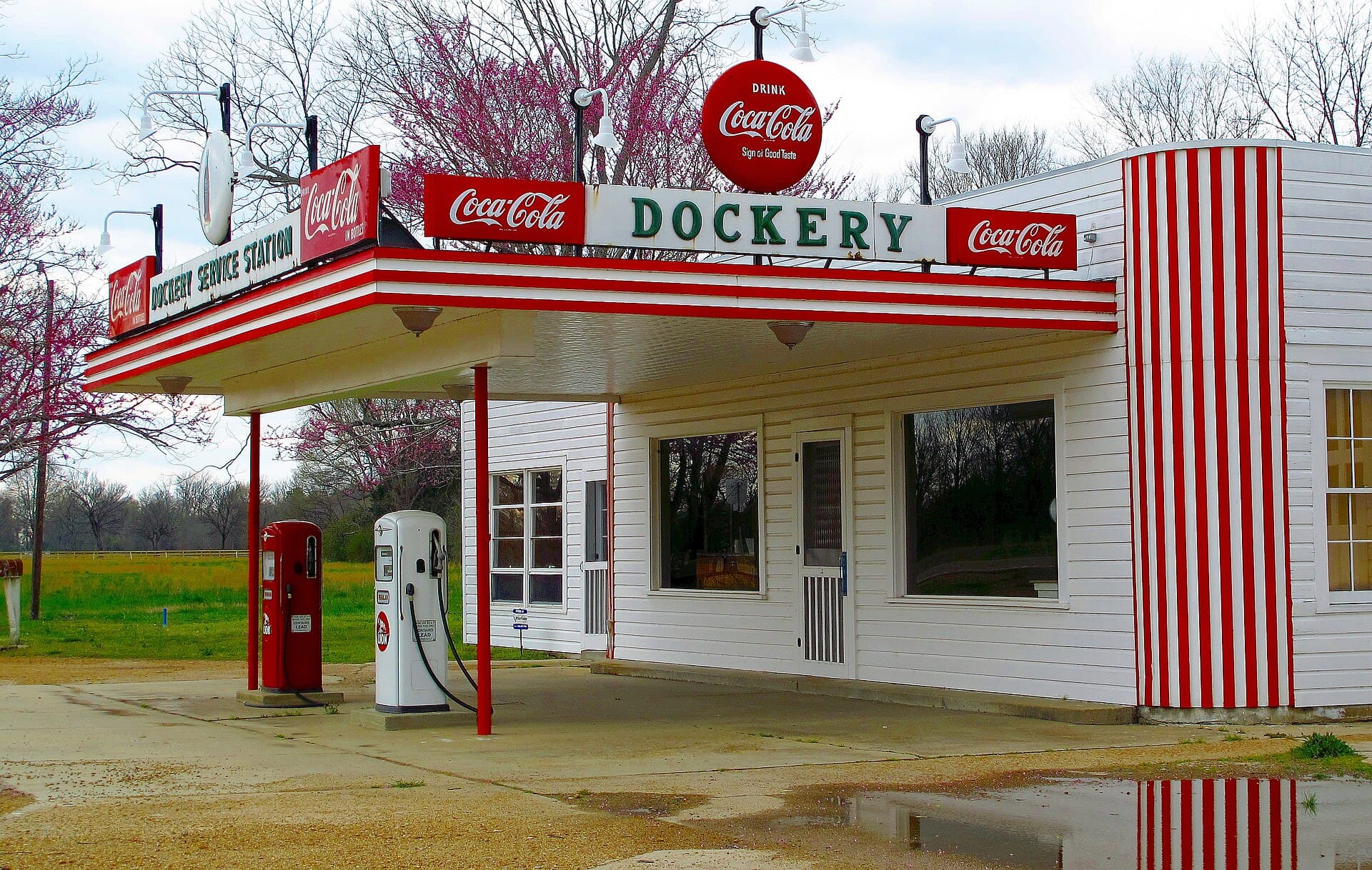
Will Dockery began buying Delta timberland outside Cleveland in the mid 1880s, fresh out of the University of Mississippi at twenty, with a thousand dollars from his grandmother, and by 1895 he had enough to put his name on the place. He came for the timber and found the bottom soil better than the trees. What he built was less a farm than a small country: a cotton gin, a commissary, a post office, a doctor, a school, a depot on the railway, and its own currency in the form of scrip, which nearby towns would honour. By the early twentieth century four hundred tenant families lived on it. The blues historians came later, and found that an unusual number of the first recorded Delta musicians had lived or played here, among them Charley Patton, Willie Brown, Tommy Johnson, Howlin' Wolf and Roebuck Staples. Patton anchors the claim. He arrived as a boy around 1900, learned from a Dockery resident named Henry Sloan, and used the place as a base on and off for nearly thirty years, playing the commissary porch and the all night picnics Dockery hosted for his tenants. He put it into the records: Pea Vine Blues is about the branch line that stopped at Dockery and ran west to Boyle, and 34 Blues opens with the plantation manager putting him off the property. The line was not Dockery's own, whatever the tourist literature says; it was the Yazoo and Mississippi Valley's Kimball Lake branch, and the rails went for scrap in 1942. B. B. King put the larger claim with its hedge intact: pick one single spot as the birthplace of the blues, he said, and this is where it might be said to have started. The marker at the site is titled with a question mark.
Dockery Farms on Whistlestop →Bryant's Grocery
Read
The collapsed brick shell at Money, swallowed by vines, was Bryant's Grocery and Meat Market. On 24 August 1955 a fourteen year old from Chicago named Emmett Till went in to buy sweets while visiting relatives, and Carolyn Bryant, minding the counter, afterwards said he had behaved improperly toward her, which the cousins with him disputed at the time. Four days later her husband Roy Bryant and his half brother J. W. Milam took Till from his great uncle's house before dawn, beat him, shot him, wired a cotton gin fan round his neck and put him in the Tallahatchie River. His mother Mamie Till Bradley insisted on an open casket. An all white, all male jury acquitted both men after sixty seven minutes, and months later the two sold a confession to Look magazine for four thousand dollars, safe from a second trial. The killing is reckoned one of the events that set the civil rights movement moving, and the ground stays contested. In 2017 the historian Timothy Tyson published an account in which Carolyn Bryant recanted the central accusation; the words are not on his recordings, she told the FBI she never said them, and her daughter in law, who sat in on the interviews, said the same. The Justice Department closed the case in 2021, a grand jury declined to indict her in 2022, and she died the following April. The store stands unrestored, owned by the children of a man who sat on the jury that acquitted; in 2011 that family took a hundred and fifty two thousand dollars of civil rights restoration money to restore the service station next door while the store fell in. A Freedom Trail marker is all that explains the site; the interpretation is thirty miles away at Sumner.
Bryant's Grocery on Whistlestop →Robert Johnson's Grave
Read
Robert Johnson died on 16 August 1938 at the Star of the West plantation north of Greenwood, twenty seven years old, having recorded twenty nine songs in two sessions. His death certificate names the burial place only as Zion Church, and there is more than one, so for sixty years nobody could say which. Three now carry a stone for him. The Atlanta band the Tombstones paid for one at Payne Chapel in Quito in 1990. Columbia Records and public donors put up a one ton obelisk at Mount Zion near Morgan City in 1991, through the Mt. Zion Memorial Fund. And in 2002 the researcher Stephen LaVere paid out of his own pocket for a marker in the cemetery beside Little Zion Missionary Baptist Church on Money Road, a few miles north of Greenwood. That third one is where the Mississippi Blues Trail put its official gravesite marker, and the reason is a witness rather than a document. In 2000 a woman the Blues Trail records as Rose Eskridge, then eighty four, said her husband Tom had dug the grave. She had been twenty two, and she remembered carrying water out to him from the Wade place, the same Star of the West plantation where Johnson had died, and the grave going in under a pecan tree at the back of the Little Zion churchyard. She also placed Jim Moore, the name written as informant on the death certificate and until then a blank, and described the plain wooden box. How he died is its own argument: the certificate says syphilis and records no doctor in attendance, and the famous poisoned whiskey story is testimony gathered decades afterwards.
Robert Johnson's Grave on Whistlestop →Baptist Town
Read
Baptist Town is one of Greenwood's oldest Black neighbourhoods, settled in the closing decades of the nineteenth century by people working the plantations, gins and mills as the cotton business pulled labour into the town. Residents hold that it was among the first places in the Delta where freed families could buy and own property, a tradition the neighbourhood has carried for generations, though no deed research has been published to settle it either way. It sits east of downtown, cut off from it by the railroad tracks and a bayou, and it is anchored by McKinney Chapel Missionary Baptist Church and by a cotton compress that no longer presses anything. For a few blocks of small houses it has been photographed, filmed and studied a great deal. Robert Johnson lived on Young Street in the summer of 1938, as did David Honeyboy Edwards, who is the source for Baptist Town being Johnson's last address. He was taken ill playing at a juke joint, by most accounts the one at Three Forks where Highways 82 and 49E meet outside town, though some accounts put it in Baptist Town itself, and he died days later at the Star of the West plantation a few miles north. That association is why visitors come, and it is a thin reason to come. Between 2013 and 2015 a reinvestment project led by the Delta Design Build Workshop with Mississippi State's Carl Small Town Center and the Fuller Center built eleven new houses here, rehabilitated fourteen more, and added a community centre, a playground and sidewalks.
Baptist Town on Whistlestop →Cotton Row
Read
Cotton Row is a three block district in downtown Greenwood, bounded by Front Street along the Yazoo River, Main Street, Market Street and Cotton Street, and for most of a century it was where the Delta's crop was graded and sold. Cotton offices lined Front and Market; the earliest use of the name recorded locally is an 1895 newspaper item about buildings on West Market. Inside them, graders judged the quality of each bale the way cotton has always been judged, by hand and eye under north light, and factors sold it. Two railroads reached the town around 1886 and put lines through to the riverfront, and by 1900 Greenwood had become what the National Register nomination calls the state's major cotton market, holding the trade well into the 1940s. What made it a market rather than merely a shipping point was the levees, which opened hundreds of thousands of Delta acres, and the shift to grading and selling cotton on the spot instead of consigning it to factors in Memphis and New Orleans. A sign on the Keesler Bridge over the Yazoo, put up by the Jaycees around 1940, called Greenwood the world's largest inland long staple cotton market, and every word in that is doing defensive work. The boll weevil reached Mississippi in September 1907 and had the whole state by 1915, but the Delta suffered least of anywhere, because its soil ripened a crop that could be picked before weevil numbers peaked, and state historians argue the planters made more of the damage than it deserved. The district was listed on the National Register in 1980, fifty seven buildings, and most of them still line the streets, a good many of them empty.
Cotton Row on Whistlestop →Club Ebony
Read
Club Ebony was built at Indianola just after the Second World War by a local entrepreneur, Johnny Jones, who bought the Hanna Avenue property with his wife Josephine in November 1945 and had the room open by about 1948. It became one of the most important Black nightclubs in the South, and the bookings were not a local circuit: Count Basie, Ray Charles, Bobby Bland, Little Milton, Albert King and Willie Clayton all played it, along with B. B. King. Jones had run other rooms in the town, among them the Jones Nite Spot on Church Street, where a boy called Riley King used to watch Louis Jordan, Jay McShann and Sonny Boy Williamson through the gaps in the wall slats. Church Street carried a dozen more places, the Cotton Club, the Blue Chip, Stella B.'s and the Key Hole Inn among them, though most of those offered blues from a jukebox rather than a stage. Its later history is one man refusing to let the room close. King came back for a homecoming every year from 1980 and made a late night set at Club Ebony the end of it, and when Mary Shepard retired in 2008 after thirty four years he bought the building himself rather than see it shut, giving it to the B. B. King Museum in 2012. The museum stands about three hundred yards away in a brick cotton gin of around 1905, picked by two architectural surveys on the merits before King mentioned that he had worked in it. The club closed in 2020, was found to be leaking through its roof and walls, and reopened in June 2023 after a restoration costing more than eight hundred thousand dollars that kept the metal ceiling and the old recessed neon.
Club Ebony on Whistlestop →Charley Patton's Grave
Read
Charley Patton was the first great figure of the Delta blues, a small, loud, theatrical performer who by Son House's account clowned for a crowd by playing the guitar behind his back and between his knees, thirty years before Jimi Hendrix, and whose records shaped Howlin' Wolf, Tommy Johnson and Robert Johnson. He cut some sixty sides between 1929 and 1934, first for Paramount and at the end for Vocalion, and he was well enough regarded at Paramount to bring Son House to the label in 1930, so the influence ran through the studio door and not only through the music. He died of a heart condition on 28 April 1934 on the Heathman-Dedham plantation near Indianola, in his forties, though the sources put his birth anywhere between 1881 and 1891. He was buried at Holly Ridge in a grave nobody marked. It stayed unmarked for more than half a century, in a small cemetery beside a cotton gin, and the location survived in one man's memory. In the early 1990s Skip Henderson of the Mt. Zion Memorial Fund and Jim O'Neal of Living Blues tracked down the cemetery's longtime caretaker, Joseph Howard, known as Cootchie, who had been ten years old in 1934 and could walk out and point at the spot. John Fogerty of Creedence Clearwater Revival paid for a headstone, bought in 1990 and dedicated in July 1991, because, as he put it, a man so great had nothing to mark his life on earth and his name had not travelled as far as his influence. The Mississippi Blues Trail chose the grave for the first marker in the series, unveiled on 11 December 2006. The gin still stands beside the cemetery.
Charley Patton's Grave on Whistlestop →The Rust Cotton Picker
Read
On 31 August 1936 Mack Rust demonstrated the mechanical cotton picker he and his brother John had built, on a private farm designated by the Delta Experiment Station at Stoneville, and several hundred planters, ginners, bankers, scientists and government men came to watch. John was not there; he was in the Soviet Union, delivering two of the ten machines the brothers had made. The insight behind it was his and it came from childhood. A spindle that grips cotton firmly enough to pull it from an open boll will not let go of it again, and Rust remembered how cotton had stuck to his fingers picking in the early morning dew, got out of bed, licked a nail, twirled it in a wad of absorbent cotton and found it would work. Smooth spindles, wetted with water, and the fibre stripped off cleanly afterwards. In an hour it picked four hundred pounds, about four days of hand work. It also knocked cotton to the ground, gathered leaf and stem that lowered the grade, and left between a quarter and a half of the crop standing on the first pass. The reviews were mixed and the alarm was not: this was the seventh year of the Depression, and the Jackson Daily News wrote that the machine should be driven right out of the cotton fields and sunk in the Mississippi river together with its plans. John Rust was a socialist who had stood for the Senate on the Communist ticket in Texas, and he meant to lease the machine only to growers who would pay a minimum wage and forgo child labour. What beat him was capital: bankrupt by 1940, and wartime steel went to International Harvester, whose barbed spindles and doffer took a whole crop at Hopson in 1944.
The Rust Cotton Picker on Whistlestop →Jim Henson's Deer Creek
Read
Jim Henson was born at Greenville in 1936 and spent most of his boyhood at Leland on the banks of Deer Creek, the family moving to Maryland when he was about a year old and back again in time for his first year at school, then away for good when he was twelve. The creek and the woods along it are what the town builds its claim on, and it is a fair one: an exhibit on the bank called Birthplace of the Frog, opened in the early 1990s, was given to the people of Leland by the Jim Henson Company, and it holds a tableau of Kermit on the creek with a banjo along with material from the Jim Henson Legacy. The original Kermit went to the Smithsonian in 2010. Henson was recruited out of his high school puppet club in 1954, at seventeen, to make puppets for a Washington television station, and Sam and Friends began the year after that. The naming story is the part to be careful with, and it runs the opposite way to how the town tells it. Henson did have a Leland friend called Kermit Scott, who was real and whose family remembered the two of them running up and down the creek. But Karen Falk, the Henson archivist, records that Henson always said the frog was not named after the boy, and that he simply liked the sound of the name, the hard consonants and the slight nasal quality of it. Nor was the first Kermit a frog. The 1955 puppet made for Sam and Friends, from a discarded coat of his mother's and two halves of a ping pong ball, was a vague lizardish thing with rounded feet, and the collar and the frog came in 1969. Deer Creek is an old Mississippi distributary, severed from the river when the levees went up, and it runs through the middle of Leland rather than round it.
Jim Henson's Deer Creek on Whistlestop →Muddy Waters's Birthplace
Read
McKinley Morganfield was born in the Jug's Corner community of rural Issaquena County, in 1913 or 1914 or 1915 depending on which record is believed, and he claimed Rolling Fork as his birthplace for the rest of his life, which is why the marker stands on a courthouse lawn in Sharkey County rather than where he was born. His mother died soon afterwards and his grandmother Della Grant raised him, giving him the name that stuck and moving him while he was still a young child to Stovall Farms outside Clarksdale, a hundred miles north. So the Delta claims him at both ends and almost nothing of him survives at either. What he carried to Chicago in 1943 was the acoustic bottleneck style he had learned around Stovall; the electric band sound came afterwards, built on a guitar he came by in the mid 1940s, bought or given by an uncle depending on the telling. Alan Lomax and Fisk University's John Work III had recorded him at Stovall in 1941 and Lomax returned in 1942, so the player he was before Chicago is preserved on disc, which very few who made that journey can claim. Rolling Fork itself was torn open on the evening of 24 March 2023 by a tornado that touched down in Issaquena County, the county he was actually born in, reached EF4 as it crossed into Sharkey and killed thirteen people in the town. Satellite analysis three years on found about half the town's structures had been damaged or destroyed, with recovery running fastest on the larger houses and slowest on the mobile homes where most of the dead had been. Any description of the town written before that night describes a place that no longer exists in the same form.
Muddy Waters's Birthplace on Whistlestop →The Bentonia School
Read
Bentonia, a town of about three hundred people in Yazoo County, has its own school of blues, recognised by musicologists and named for the town. It is built on an open tuning to a minor rather than a major chord, which Skip James called cross note, and the name is the point: the tuning lets a player cross between major and minor tonalities in a way standard blues tunings make awkward. The result is eerie and unresolved. The scholarship agrees about the subject matter, David Evans describing lyrics that deal in loneliness, death and the supernatural, and the state marker specifying songs that bemoan the work of the devil. The style is credited to Henry Stuckey, a Bentonia guitarist who told an interviewer in 1965 that he had picked the tuning up from Black soldiers in France during the First World War, then declined to be recorded and died the following year. Stuckey is known almost entirely through the men he taught. The best known was Nehemiah Curtis James, called Skip, who cut twenty one sides for Paramount at Grafton, Wisconsin in 1931, five on piano, was paid forty dollars, sold almost none into the Depression, left music for three decades and was found again in a Tunica hospital in 1964. Jack Owens, taught by Stuckey too and a contemporary rather than a successor, farmed, bootlegged, ran a juke house and played into his nineties. The Blue Front Cafe on East Railroad Avenue was opened by Carey and Mary Holmes in 1948, and the state marker calls it one of the longest existing juke joints in Mississippi. Their son Jimmy Duck Holmes has kept it since 1970, made his first record at fifty nine, and was nominated for a Grammy in 2021 for an album Dan Auerbach produced.
The Bentonia School on Whistlestop →More are waiting in the app, which carries the whole record and picks up whatever is near the road ahead, ready to narrate as you drive.
How long to give it
A long day
Clarksdale in the morning, the Stovall spur, then south to Dockery by way of Tutwiler. This is the spine of the story, the birth of the music and the man who carried it north, and it skips the Greenwood detour entirely.
Delta Blues Museum · The Crossroads · Muddy Waters's cabin site, Stovall · Tutwiler · GRAMMY Museum Mississippi · Dockery Farms
Two days
Base in Clarksdale for the first night and Greenwood or Indianola for the second. Day one runs Clarksdale and the central Delta; day two takes the Greenwood detour east for Robert Johnson, then comes back west through Indianola and Leland. Book something in Clarksdale for a Friday or Saturday night before you set out.
Delta Blues Museum · Riverside Hotel · The Crossroads · Red's Lounge · Muddy Waters's cabin site, Stovall · Tutwiler · Dockery Farms · Robert Johnson's grave, Little Zion · B.B. King Museum and Club Ebony · Highway 61 Blues Museum
Four days
All eighteen stops, ending at the Blue Front in Bentonia, which is a long way south and should be treated as the destination rather than a detour. Call ahead: Jimmy Duck Holmes is one man and he is not always there. Vicksburg or Jackson is the sensible finish.
Delta Blues Museum · Riverside Hotel · WROX and the New World District · Red's Lounge · The Crossroads · Muddy Waters's cabin site, Stovall · Tutwiler · Parchman Farm · Po' Monkey's · GRAMMY Museum Mississippi · Dockery Farms · Robert Johnson's grave, Little Zion · Baptist Town · B.B. King Museum and Club Ebony · Charley Patton's grave, Holly Ridge · Highway 61 Blues Museum · Muddy Waters's birthplace, Rolling Fork · Blue Front Cafe, Bentonia
When to come
April and October are the two good months, and April has the better reason: Clarksdale's Juke Joint Festival falls on a Saturday in the middle of it and is the best single day of live music in the Delta. October gives the same mild weather without the crowds, and the cotton is still in the fields, which changes how the whole landscape reads.
Summer is genuinely hard here. Delta heat runs into the high nineties with humidity to match from June into September, there is no shade at a roadside marker, and several of the smaller sites keep shorter hours or close. Winter is mild, quiet and workable for the museums, but the juke joints thin out and some of the small-town places keep to weekends only.
Know before you drive
- There is no fee for any Blues Trail marker. The four museums charge separately; B.B. King in Indianola was $15 for adults in 2026 and is the most expensive of them.
- Read the marker texts before you go. Every one is published at msbluestrail.org, and the signs carry more history than most of the sites do.
- Distances are longer than the map suggests and services are thin. Fill the tank in Clarksdale, Cleveland, Greenwood or Indianola rather than counting on the towns between them, and do not assume a small town has a restaurant open after dark.
- Several stops are on gravel or unpaved farm roads, including Holly Ridge and the approach to Po' Monkey's. They are passable in an ordinary car in dry weather and unpleasant after heavy rain.
- Little Zion and Holly Ridge are active churchyards and cemeteries, and Baptist Town is a residential neighborhood where people live. Park considerately, keep the noise down and do not photograph houses or people without asking.
- Parchman Farm is an operating prison. The marker is at the gate on Highway 49W; do not attempt to enter, and do not photograph the facility.
- Juke joint hours are not really hours. Red's opens when it opens, and the Blue Front depends on whether Jimmy Duck Holmes is there, so call ahead if it is the reason for your trip.
In an RV or with a trailer
The Delta is flat, the highways are wide and straight, and an RV handles the main route between Clarksdale, Cleveland, Indianola and Greenwood without difficulty. The exceptions are the gravel spurs: Holly Ridge cemetery, the lane to Po' Monkey's and the Stovall road are tight, soft-shouldered and awkward to turn a long rig around on, so park on the highway and walk in, or take the tow car. Small-town parking is generally easy, but several downtown Clarksdale stops sit on narrow one-way streets where a large vehicle is more trouble than the two-block walk.
Questions
- Where is the crossroads where Robert Johnson sold his soul?
- Nowhere documented. The legend attaches to no verified location and was originally told about a different musician, Tommy Johnson. Clarksdale marks the junction of Highways 61 and 49 with three blue guitars, on the strength of a 1999 state legislative resolution, and a 2004 renumbering means the monument does not stand exactly where those roads once crossed. It is still the place people go.
- Which of Robert Johnson's three graves is the real one?
- Little Zion Missionary Baptist Church on Money Road north of Greenwood is the accepted site. Rosie Eskridge came forward in 2000 to say her husband Tom dug the grave and she was present, and the Mississippi Blues Trail marker is there. The other two, at Quito and Morgan City, were placed in 1990 and 1991 on weaker evidence.
- Where was the blues invented?
- No single place, but Dockery Farms near Cleveland has the strongest claim, and B.B. King endorsed it on camera. Charley Patton lived there on and off for nearly thirty years and the musicians who shaped the Delta style all passed through. The earliest firsthand account of hearing the music is W.C. Handy's, at the Tutwiler railway platform around 1903.
- Can you still visit Po' Monkey's?
- You can see the building and the marker, but it has not operated since Willie Seaberry died in July 2016. It was the last of the rural Delta juke joints. For a working one, Red's Lounge in Clarksdale and the Blue Front Cafe in Bentonia are both still going.
- How many days does the Mississippi Blues Trail take?
- The Delta section in this guide works as a long day for the essentials, two days at a reasonable pace, or four to take all eighteen stops including Bentonia in the south. The full trail statewide is more than 200 markers and is not a single trip.
- Is the Riverside Hotel in Clarksdale open?
- Partly. The family closed it for structural repairs in January 2025 and opened a museum in the front rooms in October that year; overnight rooms were expected back during 2026. Check directly before counting on a bed there.
Connects to
Sources: The Mississippi Blues Trail, marker texts and locations, Mississippi Encyclopedia, Center for Study of Southern Culture, Delta Blues Museum, Clarksdale, B.B. King Museum and Delta Interpretive Center, Dockery Farms Foundation, Riverside Hotel African American Historic Preservation Center, The Great Migration, National Archives.
Reviewed August 2026
Hear it from the road
Whistlestop tells you these stories automatically as you pass them. No searching, no tapping, nothing to ask.