Live on the road
Selma to Montgomery Audio Tour
Whistlestop narrates far more of the drive than this guide can list, automatically, as you pass each one.

The field guide
Three marches
There were three attempts, and the first two failed. What set them going was a killing thirty miles northwest of here: on 18 February 1965, at a night march in Marion, an Alabama state trooper named James Bonard Fowler shot a 26-year-old woodcutter and church deacon called Jimmie Lee Jackson in the stomach as Jackson tried to shield his mother from a beating. Jackson died eight days later. The idea of walking his body, or the fact of it, to the governor in Montgomery came out of the funeral.
On Sunday 7 March about 600 people left Brown Chapel and walked six blocks to the bridge. State troopers and Dallas County deputies, some mounted, gave them two minutes to disperse and attacked inside of one, with nightsticks and tear gas. At least fifty people needed hospital treatment. John Lewis, then 25 and leading the column with Hosea Williams, had his skull fractured. ABC interrupted its Sunday film to run the footage, and the day acquired its name.
On Tuesday 9 March King led roughly 2,000 people back to the bridge, stopped at the police line, knelt, prayed and turned them around, under a restraining order he had decided not to break. That evening three white Unitarian ministers who had come to Selma were attacked on the street after dinner. One of them, James Reeb, died in a Birmingham hospital on 11 March.
On 17 March, after five days of testimony, Federal District Judge Frank M. Johnson Jr. ruled that the march could proceed under federal protection, and drew a line that shapes how this route is remembered: unlimited numbers at the start and the finish, but no more than 300 people along the 22 miles where US 80 narrowed to two lanes through Lowndes County. About 3,200 set out from Selma on 21 March. For two days in the middle there were three hundred. By the Capitol on 25 March there were 25,000.
That night, driving marchers back to Selma, Viola Liuzzo was murdered on the highway. President Johnson signed the Voting Rights Act on 6 August 1965, five months after Bloody Sunday.
The name on the bridge
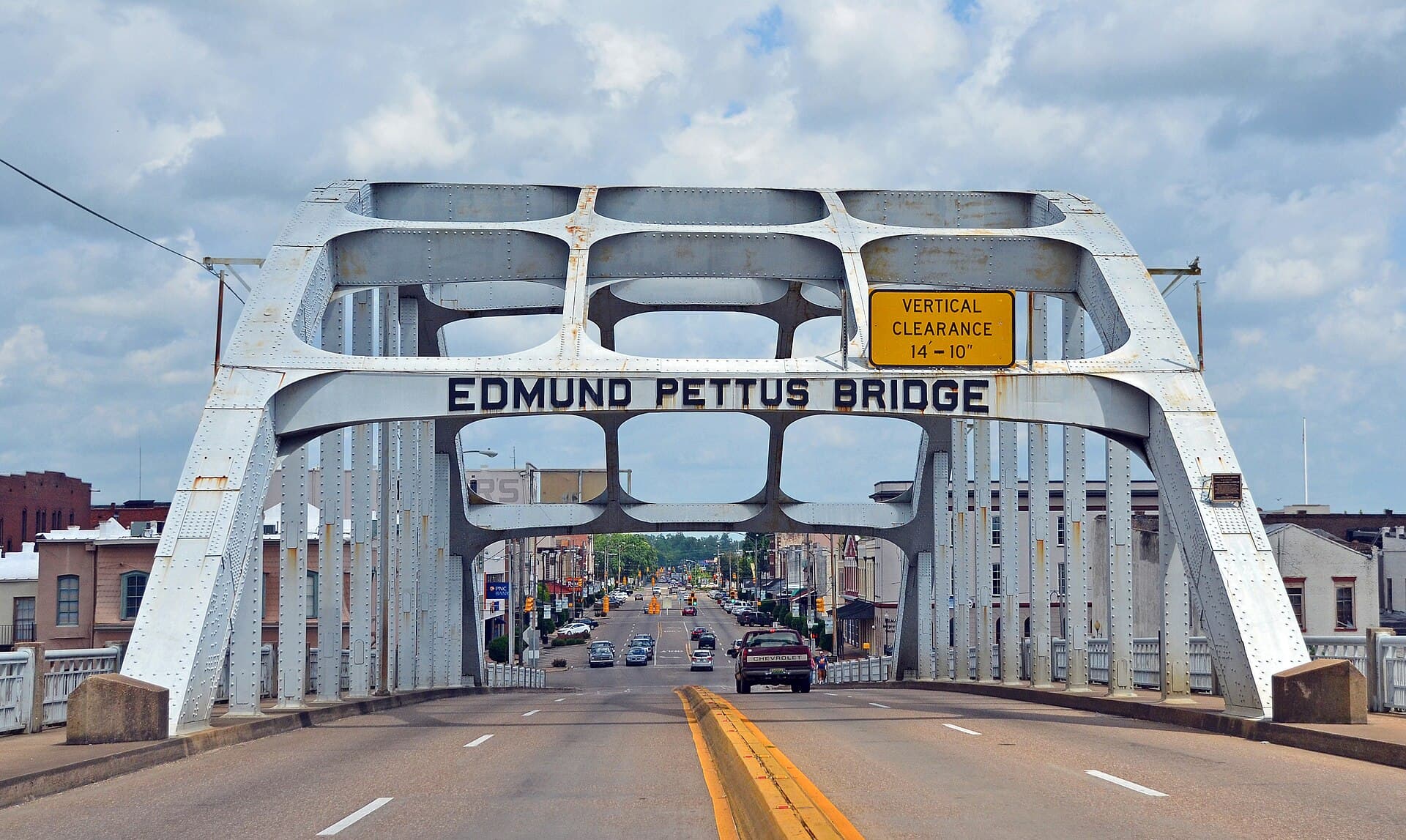
The bridge opened in 1940 and was named for Edmund Winston Pettus, who had been a brigadier general in the Confederate army, a United States senator for Alabama, and, from 1877, Grand Dragon of the Alabama Ku Klux Klan. None of that is disputed and none of it is obscure; the name is cast in letters four feet high across the arch, which is why every photograph of the place carries it.
The obvious conclusion is that it should be renamed, and after John Lewis died in 2020 a petition to call it the John Lewis Bridge passed two hundred thousand signatures. Alabama's congresswoman Terri Sewell, whose district this is and who is from Selma, supports a change.
The people who were actually on the bridge in 1965 do not agree with each other, and that is worth knowing before you form a view. Lynda Blackmon Lowery, who was fourteen that Sunday and took thirty five stitches to the head, does not want it renamed for anybody: it is not a monument, she has said, it is a part of history. Her younger sister Jo Ann Bland, also there at fourteen, opposed renaming for years and then moved toward supporting it, though for the local foot soldiers rather than for Lewis, because, as she put it, she and John were not the only ones there. Others in Selma argue that Pettus's name has been captured by what happened on his bridge and now means the opposite of what he did, and some in a poor town with little industry left simply do not want the name that draws the visitors changed.
Nothing has been renamed. The debate is live, and the guide does not have a vote in it.
The fifty four miles
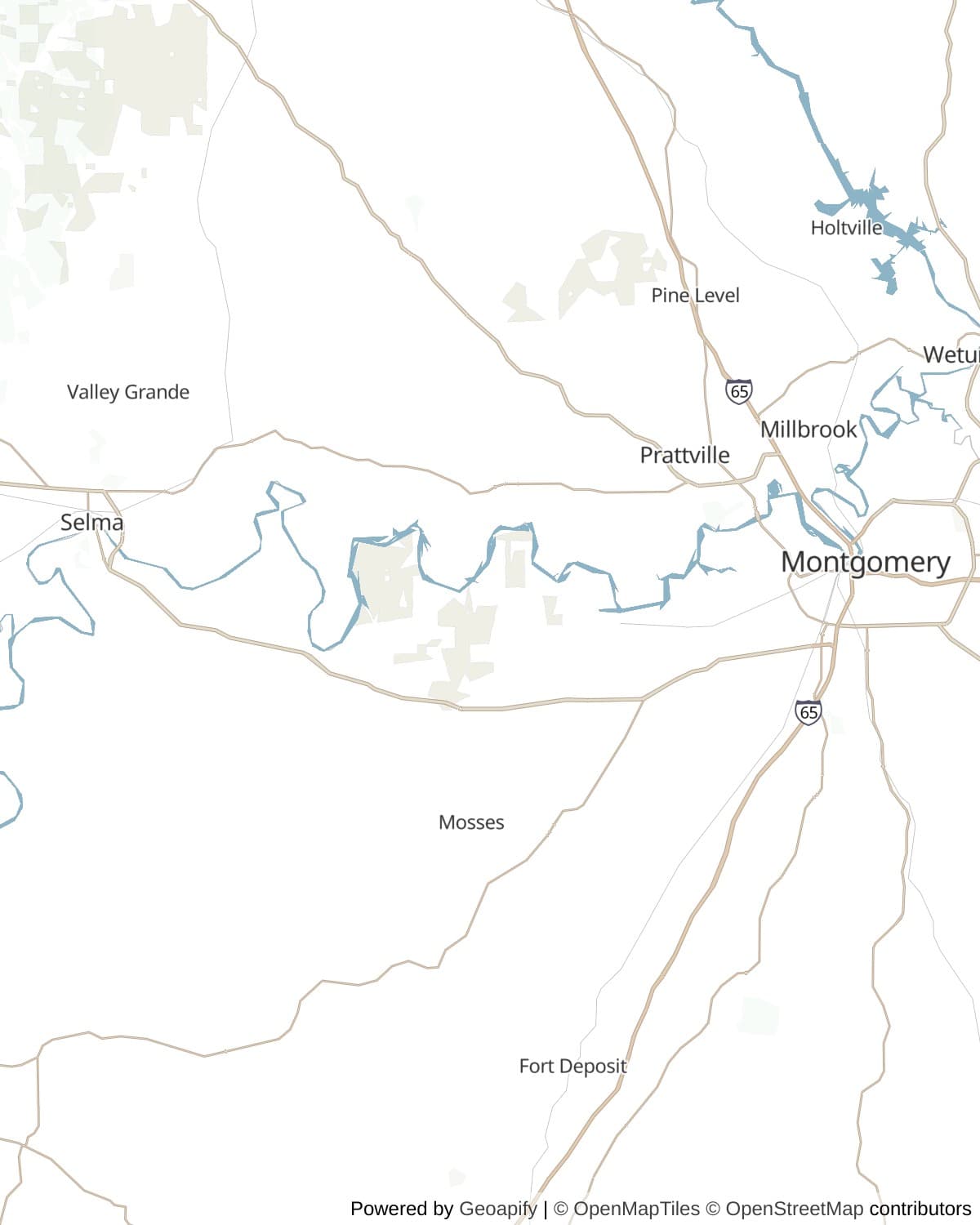
US 80 today is mostly four lanes with a grass median, running east through the Black Belt, the band of dark prairie soil that made this cotton country and then made it poor. There is not a great deal to look at, and that is close to the point: the distance is the exhibit. Five days is a long time to walk in the rain in March, and the road gives you a physical sense of it that no museum can.
The four campsites are the human centre of the route, and all four turned on somebody's decision to say yes. Three of them were the farms of Black landowners: David Hall, Rosie Steele and Robert Gardner. Owning land was the thing that made saying yes possible, since a tenant could be put off the place by Friday, and it did not make them safe. Steele's suppliers boycotted her store. The Gardners had their phone and power lines cut and were offered money to refuse. The fourth site, the City of St. Jude, was a Catholic mission on the edge of Montgomery with the hospital that would treat Black patients.
Two of those farms, Hall's and Gardner's, went onto the National Trust for Historic Preservation's list of America's eleven most endangered historic places in 2021, which is a polite way of saying that the buildings are falling down. Brown Chapel joined the list in 2022. There is no visitor centre at any of the campsites and in some cases not much to see from the road beyond a sign, so read the marker, look at the field, and understand that several thousand people slept in it.
The one stretch that still looks like 1965 is the two-lane section through Lowndes County, the twenty two miles where Judge Johnson capped the march at three hundred. Driving it takes about twenty five minutes. It took them two days.
Bloody Lowndes
The county in the middle of this route was known by a nickname before the march and kept it afterwards. Lowndes County was about eighty percent Black. Roughly 5,100 Black residents were old enough to vote, and not one of them was registered.
The Voting Rights Act changed the law in August and did not change the county. Black families who registered were fired and evicted from land they had farmed for generations, and by the end of the 1965 cotton season people were living in tents on six acres beside the highway, put up by SNCC and the Lowndes County Christian Movement for Human Rights. Tent City lasted more than two years. The federal interpretive centre for the trail stands on that ground now.
What the county did next is the part most people do not know. Alabama required political parties to carry a ballot emblem, because literacy tests had left many voters unable to read the names, and the state Democratic Party's emblem was a white rooster over the words White Supremacy For the Right, which had been there since 1904 and which the party voted 39 to 32 to strike in January 1966. Organisers asked local people what emblem they wanted for a party of their own. The answer, as Stokely Carmichael told it, was that they needed a mean black cat to run that white rooster out of the county.
The Lowndes County Freedom Organization was formed in 1966 with a black panther on the ballot. Its candidates lost that year. Two years later, in Oakland, Huey Newton and Bobby Seale took the symbol for a party of their own, which is how a logo drawn for illiterate voters in an Alabama cotton county became the emblem of the Black Panther Party.
On 20 August 1965, in the county seat at Hayneville, a part-time deputy named Tom Coleman shot and killed Jonathan Daniels, a 26-year-old Episcopal seminarian, as Daniels pushed a 17-year-old activist named Ruby Sales out of the way of the shotgun. An all-white jury acquitted Coleman after a trial that took less than an hour.
What the law did, and what happened to it
The Voting Rights Act of 1965 worked, and quickly. Its Section 5 required jurisdictions with a history of discrimination, which meant most of the South including every county on this road, to get federal approval before changing any voting rule. Registration in Alabama's Black Belt went from almost nothing to majorities within a few years, and Lowndes County has elected Black officials ever since.
The prosecutions took longer, or never came. Nobody was convicted of killing James Reeb: three men were tried and acquitted by an all-white jury in December 1965, the case was reopened under the Emmett Till Unsolved Civil Rights Crime Act in 2008, and the Justice Department closed it in 2011 without charges. It is officially unsolved. Tom Coleman died in 1997, never having been convicted of anything. James Bonard Fowler, who shot Jimmie Lee Jackson, was indicted in 2007, pleaded guilty to second-degree manslaughter in November 2010, and served six months.
The one that ran the other way was Liuzzo's. Federal prosecutors could not get a state murder conviction, so they charged three Klansmen under an 1870 civil rights statute instead and won, which was itself part of the argument for the federal enforcement powers that went into the Act.
On 25 June 2013, in Shelby County v. Holder, the Supreme Court struck down the formula in Section 4(b) that determined which places Section 5 applied to, which left the preclearance requirement standing but with nothing to attach it to. The case was brought by Shelby County, Alabama, about eighty miles north of the bridge. Congress has not replaced the formula. That is not an argument this page is making; it is where the road ends, and it is why people still walk across the bridge every March.
How long to give it
One day
Enough to drive it end to end and understand the shape. Start in Selma early, walk the bridge on foot before the heat, then take US 80 east with a long stop at the Lowndes Interpretive Center, which is the best single hour on the route. Reach Montgomery by mid-afternoon for the Capitol steps. This version does not fit the Legacy Museum in, and you should not try to make it.
Brown Chapel AME Church · The Edmund Pettus Bridge · Lowndes Interpretive Center and Tent City · Viola Liuzzo Memorial · The Alabama State Capitol
Two days
The right length. Give the first day to Selma and the road, sleeping in Montgomery, and the second entirely to Montgomery: the Legacy Museum in the morning, the National Memorial after lunch, the Capitol and Dexter Avenue in the late afternoon. The two days are different in kind, and doing the museum on a day when you have already driven fifty four miles does it no favours.
Brown Chapel AME Church · The Edmund Pettus Bridge · David Hall Farm, Campsite 1 · Rosie Steele's place, Campsite 2 · Lowndes Interpretive Center and Tent City · Viola Liuzzo Memorial · City of St. Jude, Campsite 4 · The Alabama State Capitol · The Legacy Museum and the National Memorial for Peace and Justice
When to come
Early March is the anniversary, and it is a different trip. The Bridge Crossing Jubilee fills Selma for a long weekend around 7 March with a re-enactment walk, a commemorative service at Brown Chapel and a great many people who were there in 1965 or are descended from someone who was. It is the best time to come and the hardest: book months out, expect road closures, and understand that you are a guest at somebody's commemoration rather than a visitor to an attraction.
Spring and autumn are otherwise the sensible windows. March through May and late September through November give you the mild, dry weather this route wants, since a good deal of it is standing outside reading markers with no shade.
Summer in the Black Belt is heavy: high nineties, high humidity, and afternoon thunderstorms that arrive fast. The interpretive centres are air conditioned and the campsites are open fields. Winter is quiet and workable, with highs in the fifties and sixties, though January and February can be wet.
Know before you drive
- The Selma Interpretive Center is closed for major construction until 2028. The National Park Service is running it from the Selma Welcome Center in the meantime, Monday to Saturday 9 to 4.30. The Lowndes and Montgomery centres are open on the same hours and are unaffected.
- Brown Chapel AME has been closed to the public since 2020 for structural restoration and was expected to complete in late 2026. Check before you go if getting inside matters to you; the exterior, the plaza and the monument are accessible either way.
- Nothing on this route charges admission except the Legacy Sites in Montgomery, which are ticketed and do sell out. All three National Park Service centres are free, the Capitol is free, and the National Voting Rights Museum charges a modest admission.
- The National Voting Rights Museum keeps unusual hours: Monday to Thursday 10 to 4, and Friday to Sunday by appointment only. A weekend visitor who has not called ahead will find it shut.
- None of the interpretive centres open on Sunday, and all three close for Thanksgiving, Christmas Eve, Christmas Day and New Year's Day. A Sunday drive of this route is the bridge, the markers and the Capitol grounds, which is not nothing but is not the trail either.
- Walk the bridge rather than driving it. There is a pedestrian walkway on both sides, parking on the Selma side near the foot of Broad Street, and the crossing takes about ten minutes each way.
- Selma is a small town with limited places to eat and stay, and Montgomery has most of both. Fuel and mobile coverage are fine the whole way; the Lowndes County stretch is rural but never remote. There are few services between Selma and Montgomery, so fill up and use the bathroom at one end or at the Lowndes centre.
- The campsite sites are private property or open field with interpretive signs, not attractions with parking lots and staff. Read them from the pull-offs and do not walk onto the land.
In an RV or with a trailer
The route is easy in anything: US 80 is a four-lane divided highway for most of its length with the one two-lane stretch through Lowndes County, no clearance issues and no tight turns. The interpretive centres at Lowndes and Montgomery have large flat lots. Downtown Selma and downtown Montgomery are the two places to think twice, both with narrow streets and metered kerbside parking; park at the Lowndes centre or on the edge of each downtown and walk. There is no camping at any trail site.
Questions
- How long does it take to drive the Selma to Montgomery trail?
- About an hour of actual driving for the 54 miles, and a full day if you stop. Two days is better, because it lets Montgomery's museums have a morning of their own rather than being tacked onto an afternoon.
- Can you walk across the Edmund Pettus Bridge?
- Yes. There is a pedestrian walkway on both sides, it is free and open at all times, and it takes about ten minutes each way. Park near the foot of Broad Street on the Selma side. Walking it is the point; the drive across takes thirty seconds and tells you nothing.
- Why is the bridge still named after a Confederate general and Klan leader?
- Because nothing has been renamed, and because the people with the strongest claim to decide do not agree. Edmund Pettus was a Confederate brigadier, a US senator and Grand Dragon of the Alabama Klan. A petition to rename it for John Lewis drew over 200,000 signatures after his death in 2020 and Alabama's congresswoman Terri Sewell supports a change, but several of the marchers who were beaten on the bridge, including Lynda Blackmon Lowery, oppose renaming it, on the grounds that it is a record rather than a monument.
- Is Brown Chapel AME Church open to visitors?
- Not at the time of writing. It has been closed since 2020 with termite and water damage serious enough to threaten the structure, it opened briefly for the Bloody Sunday commemoration in March 2026, and restoration was expected to finish in late 2026. The exterior, the plaza and the monument outside are open, and the church remains an active congregation.
- What is there to see at the campsites?
- Fields, mostly, with interpretive signs. Three of the four were the farms of Black landowners who took real risks to host several thousand people, and two of those farms went on the National Trust's most endangered list in 2021 because the surviving buildings are deteriorating. There are no visitor facilities. The Lowndes Interpretive Center, on the site of Tent City, is where the story of this middle stretch is actually told.
- How many people marched, and why do the numbers differ so much?
- Because the court order changed them twice. About 600 set out on Bloody Sunday, 7 March. For the successful march starting 21 March, Judge Frank M. Johnson Jr. allowed unlimited numbers at the beginning and end but capped the 22-mile two-lane stretch through Lowndes County at 300. So roughly 3,200 left Selma, three hundred walked the middle, and 25,000 arrived at the Capitol on 25 March.
- Should I visit the Legacy Museum on the same trip?
- Yes, and give it its own day. The Equal Justice Initiative's museum and the National Memorial for Peace and Justice are half a mile from the Capitol steps where the march ended, and they supply the century of history that explains why people were willing to walk fifty four miles for a voter registration card. Tickets are timed and sell out, so book before you travel.
Sources: National Park Service, Selma to Montgomery National Historic Trail, National Park Service, the history of the marches, National Park Service, the Edmund Pettus Bridge, National Park Service, James Reeb, National Park Service, Lowndes Tent City, National Park Service, trail operating hours, National Voting Rights Museum and Institute, Encyclopedia of Alabama, the Selma to Montgomery March, Encyclopedia of Alabama, Jimmie Lee Jackson, Encyclopedia of Alabama, Viola Gregg Liuzzo, Encyclopedia of Alabama, James Reeb, Encyclopedia of Alabama, Jonathan Myrick Daniels, Encyclopedia of Alabama, the Lowndes County Freedom Organization, SNCC Digital Gateway, Lowndes County, Equal Justice Initiative, Black Power in America's Black Belt, National Trust for Historic Preservation, the Selma to Montgomery camp sites, Legal Defense Fund, Shelby County v. Holder, Brennan Center for Justice, the effects of Shelby County v. Holder, Department of Justice, the Jimmie Lee Jackson case file, Smithsonian Magazine, who was Edmund Pettus.
Reviewed September 2026
Hear it from the road
Whistlestop tells you these stories automatically as you pass them. No searching, no tapping, nothing to ask.